Briquette Machine without Adhesives
1, What is briquette machine without adhesives?
Briquette Machine without Adhesives, named high pressure briquette machine, dry powder briquette machine, is a kind of equipment that presses powdered raw materials into briquette without adhesives, the purpose of which is to reduce dust, increase bulk density, return for use, improve transportation characteristics, etc.
2, Where is application of Briquette Machine without Adhesives:
For powder materials that cannot come into contact with water or do not require
adhesives, as well as materials that require high hardness of the finished briquettes, briquette machine without adhesive can be considered. Due to the high forming efficiency of the riquette machine without adhesive and the high strength and density of the finished briquettes, it is not easy to break or fall off, and the finished briquettes are stable; and the
high degree of automation of the riquette machine without adhesive is widely used in the metallurgical field, chemical industry, organic fertilizer/inorganic fertilizer granulation, environmental protection industry, and building materials industry, etc.
-Metallurgical industry:Waste recycling: Processing metallurgical waste such as steel slag, iron ore powder, aluminum ash powder, silicon manganese ore powder, etc., by pressing them into ball blanks as smelting raw materials, improving the utilization rate of waste; processing metal waste such as iron filings and aluminum powder to improve recycling efficiency.
Auxiliary material molding: Press auxiliary materials such as oxidized iron sheets, dust removal ash, and pool mud into high-density pellets for direct furnace smelting.
-Chemical industry: Pressing powdered materials such as coal powder, coke, activated
carbon, fertilizer, etc. to improve transportation and combustion performance;
-Environmental protection: Reducing dust pollution by wrapping harmful substances, such as treating aluminum ash, sludge, pond mud, tailings and other industrial solid
wastes, and realizing resource utilization after pressing;
-Coal industry: Pressing bulk materials such as lignite and coal powder into regular
pellets to improve combustion efficiency and reduce transportation losses; Pressing fuels
such as coking coal and coke dust to improve energy utilization and storage
convenience;
-Refractory industry: Processing refractory powders such as magnesia, bauxite,
dolomite, etc. to make high-strength pellets for high-temperature industrial scenarios;
-Building materials and other industries: Pressing non-metallic minerals such as
gypsum and tailings for building materials production or secondary processing;
3, How is the briquette machine withtout adhesive working?
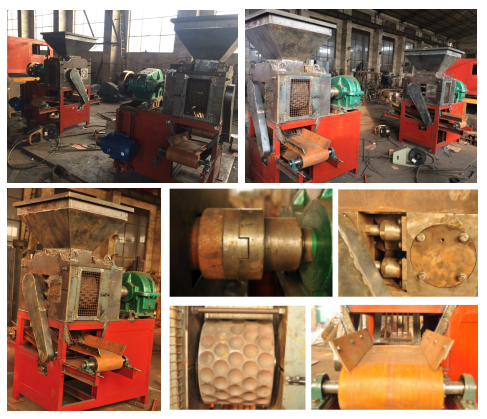
When the equipment is running, material is fed evenly and in equal amounts from the top of the equipment, and the material is forced to be discharged through the spiral pre-pressing device, and then enters the two horizontal pressing rollers. The two rollers are driven by the reducer and rotate in opposite directions at the same speed. At the same time, the material is forced to be fed between the two rollers. By adjusting the rotation of the main shaft, the space above the two rollers is always filled with materials.
The briquettes socket on the surface of the roller is in an open state to bite into the material. As the roller rotates, the ball socket enters a closed state to compress the material (also known as re-exhaust), and then the ball socket is in an open state again and is compressed into the briquette. At this time, the briquette will naturally fall out of the mold due to the unbalanced force, the elasticity of the briquette and the effect of gravity.
The whole process can increase the density of the materials by 1-3 times, thereby
achieving the required strength.
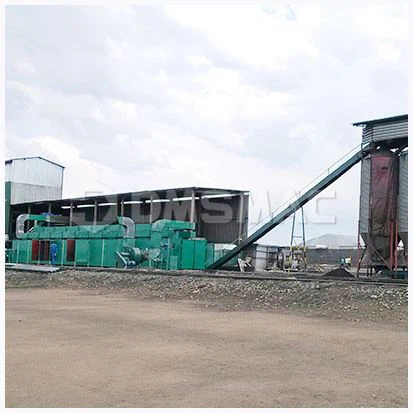
In the process of pressing , the quantitative feeding of the materials is very important, so a quantitative feeding device is often set up in the front process of the briquette press. After pressing the briquette, due to the presence of small particles, screening is very necessary. Therefore, the balls produced often have to pass through a screening device, which can be simple, such as a fixed screen, or a motor-driven screening machine.The screened materials need to re-enter the entire system for re-molding, and this entire system constitutes the lime molding process.
In addition to providing a complete set of briquette making process, DMSMAC can also provide various equipment, feeding and discharging systems customized according to customer needs, docking with on-site raw material systems and dust removal systems, or provide a complete set of PLC systems and corresponding solutions
Take Lime press system as sample:
4, Components Of Briquette Machine without adhesive:
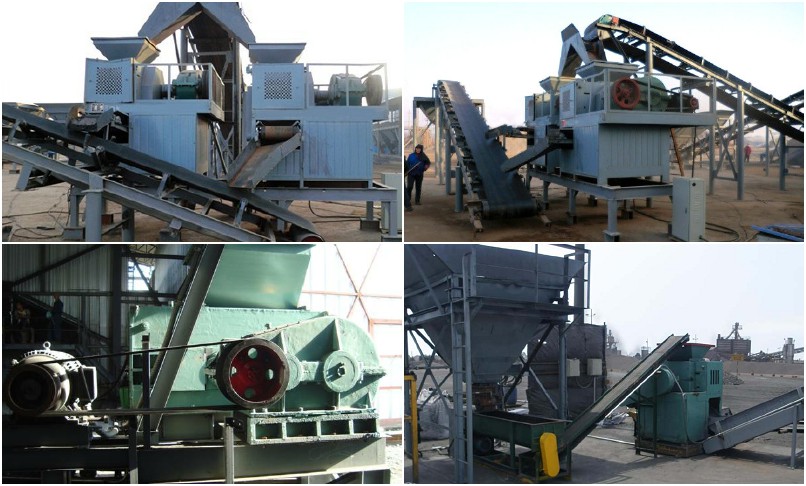
1. Feeding system: It consists of a quantitative feeding bin and a forced feeding device Quantitatively feeding bin used to feed briquette machine evenly and stably; Forced feeding device used to pressurize the materials and force it to the middle of the rollers
2.Transmission system: It is the power source and power transmission system of the briquette press. The main transmission system includes a motor, a reducer, a coupling, and a briquette groove alignment device, which are transmitted to the two roller shafts respectively.
The main power supply adopts a speed-controlled motor, which is transmitted to the driving shaft through a pulley and a cylindrical gear reducer. The open gear is between the driven shaft and the non-driven shaft to ensure synchronous operation.
3.Forming system: It is the main device for pressing materials into briquettes. It consists of a pressing roller, a main shaft, a bearing and a bearing seat, and a synchronous gear.
4. Finished briquette screening and conveying device: briquette screening and cleaning device.And transported to the storage area by belt conveyor.
5.Hydraulic system:It consists of hydraulic pump and hydraulic cylinders and oil
pipe.When there is too much feed or a metal block appears, the hydraulic cylinder piston rod is overloaded by pressure, the hydraulic pump will stop, the accumulator will buffer the pressure change, the overflow valve will open to return oil, and the piston rod will shift to increase the gap between the pressing rods, so that hard objects can pass through the pressing rods. Such a system design can protect the pressing rods from damage.
6.PLC control system: Intelligently controls the feeding and transmission devices of the briquette press.
Briquette Machine without Adhesives
Product Categories
Briquette Production Line
Roller Briquette Machine
Dryer system
Heat Source System
Mixer System
Crusher System
Auxiliary Equipment
Recommended Cases
Influence Of Pretreatment Process Of Ball Press Binder
Influence of pretreatment process of ball press binder […]
5 tons per hour fluorite powder briquette press production line
5 tons per hour fluorite powder briquette press product […]
20 Tph Coal Briquettes Plant In Heibei Province
Raw Materials : coal Moisture content: 8%-10% Productio […]
1500kgph Charcoal Briquettes Dryer Assembed At Namibia
1500KGPH Charcoal Briquettes Dryer […]
FAQ's
Frequently Asked Questions
What products does your manufacturing company produce?
We provide a wide range of machinery, including briquette machines, mixers, dryers, and more, designed for various industrial applications.
What is the typical lead time for product delivery?
Lead times vary depending on the machine and customization options. Please contact us for specific timelines related to your order.
What materials can your briquette machines process?
Our briquette machines can process a variety of materials, including biomass, charcoal, and other organic waste products.
What are the energy requirements for your machines?
Each machine has specific energy requirements, which can be provided upon request. We aim to design energy-efficient solutions.